News Summary
- George Russell believes McLaren was faster than Mercedes despite his 0.071-second advantage over Pierre Gasly in Las Vegas FP2.
- The British driver said his fastest lap benefited from the driest conditions, while Lando Norris missed the opportunity to respond.
- Russell expects a busy final practice session as Mercedes investigates its wet-weather performance and the possibility of tyre graining during Sunday’s race.
George Russell played down his fastest lap in second practice for the 2026 Las Vegas Grand Prix, admitting that McLaren appeared considerably quicker than Mercedes despite the British driver ending Friday’s running at the top of the timesheets.
Russell recorded 1:47.272 during the closing minutes of FP2, beating Pierre Gasly’s Alpine by just 0.071 seconds, while Charles Leclerc finished third for Ferrari, 0.333 seconds behind the Mercedes driver.
However, the changing conditions on the Las Vegas Strip Circuit made it difficult to establish a clear competitive order. Heavy rain had prevented every driver from setting a timed lap in FP1, while the track gradually dried throughout the second session.
“Well, we know in the wet it’s different every single lap, every single session you do. I think realistically, we probably were not the fastest today,” Russell said when asked how representative his result had been.
“McLaren looked exceptionally fast. Charles looked very fast at points. We just got the lap in. My track was at its driest and Norris didn’t run,” he continued, acknowledging that the timing of his final attempt had been decisive.
Russell’s assessment contrasted sharply with the final classification. Norris finished seventh, 1.565 seconds behind the Mercedes, while Oscar Piastri was fifth. Both McLaren drivers had shown strong pace earlier in the session, particularly as the circuit became suitable for intermediate tyres.
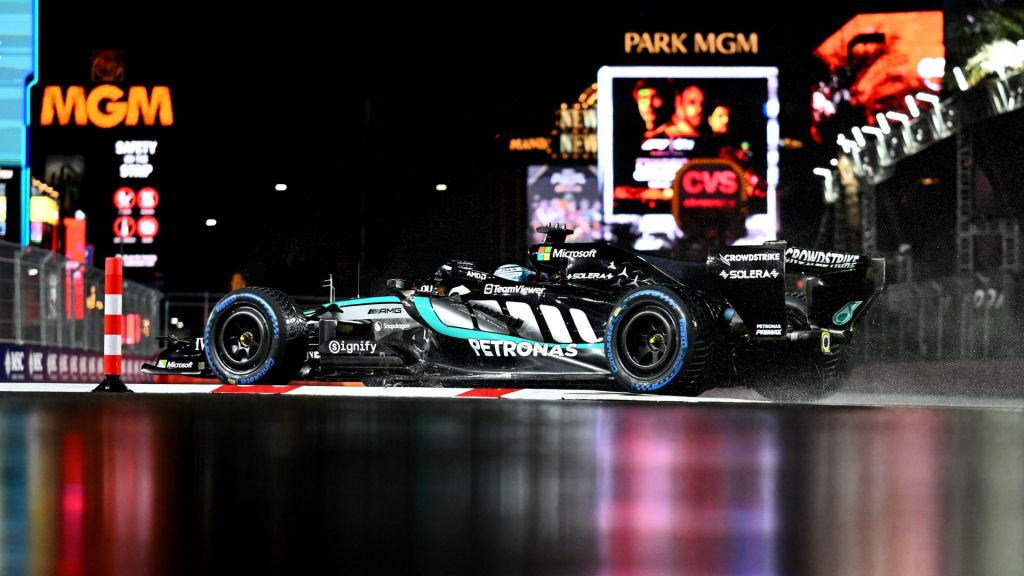 George Russell (Photo: F1)
Russell admits Mercedes has work to do despite fastest lap
Although Russell secured the best time, the British driver was dissatisfied with Mercedes’ performance in the wet conditions.
The team had appeared competitive in similar circumstances at the previous race weekend in São Paulo, but Russell felt both Mercedes drivers had struggled to reproduce that level of performance in Las Vegas.
“So, yeah, we’ve got some things to understand because we were very competitive in wet last week and both Kimi and I were off the pace,” he admitted.
Kimi Antonelli finished eighth, 1.771 seconds behind his teammate, leaving Mercedes with questions about its performance in the conditions experienced during most of Friday’s running.
The team’s preparation had already been complicated by the absence of meaningful running in FP1. With only one further practice session remaining before qualifying, Mercedes will have limited time to evaluate its dry-weather setup and race performance.
Russell expects the team to maximise its running from the beginning of FP3 rather than concentrate exclusively on qualifying simulations.
“Yeah, it will be. We’ll be out from the beginning trying to get a long run in,” he explained when asked about Saturday’s preparations.
Las Vegas tyre graining leaves Mercedes uncertain over race strategy
Russell also identified tyre graining as one of the biggest unanswered questions ahead of the Grand Prix.
The phenomenon, which involves rubber tearing away from the tyre surface and accumulating on the tread, can reduce grip and compromise performance. It has previously played a major role in determining race strategy on the cold Las Vegas circuit.
“I think nobody knows how the graining is going to be for Sunday. So last year it was an easy one stop, but the year before there was lots of graining and it was a two stop,” Russell said.
“So there are questions that we want answered, but we probably won’t get an answer until race day.”
The uncertainty reinforces the concerns highlighted in GRANDE PRÊMIO’s analysis of the cold-weather challenge facing Formula 1 in Las Vegas, where low track temperatures, tyre warm-up and degradation were identified as important factors.
With Friday’s running dominated by wet conditions, teams have not yet established a reliable picture of how the dry tyres will behave over a full race stint. FP3 will therefore be especially important for gathering the information needed to prepare for qualifying and the Grand Prix.
Despite the uncertainty, Russell remains confident in his recent form. He arrived in Las Vegas after qualifying on the front row at the previous two races and believes Mercedes can maintain that momentum.
“I feel good at the moment. The last two races on the front row in both and performances were much stronger,” he said.
“It’s a track I enjoy. So hoping for a good weekend.”
GRANDE PRÊMIO is following every session of the Las Vegas Grand Prix and the latest developments in Formula 1.
FAQ
Why does George Russell believe McLaren was faster in Las Vegas FP2?
Russell said McLaren appeared exceptionally quick throughout the changing wet conditions, while his own fastest lap benefited from a particularly dry track. Norris did not complete another attempt when conditions were at their best.
What problems did Russell identify with Mercedes in Las Vegas?
Russell admitted that both he and Kimi Antonelli had been off the pace in the wet compared with Mercedes’ performance at the previous race in São Paulo. The team needs to understand the difference before qualifying.
Why is tyre graining a concern for the Las Vegas Grand Prix?
Cold track conditions can contribute to tyre graining, potentially affecting grip and race strategy. Russell noted that the previous two editions required different strategies, with one stop in 2025 and two in 2024.